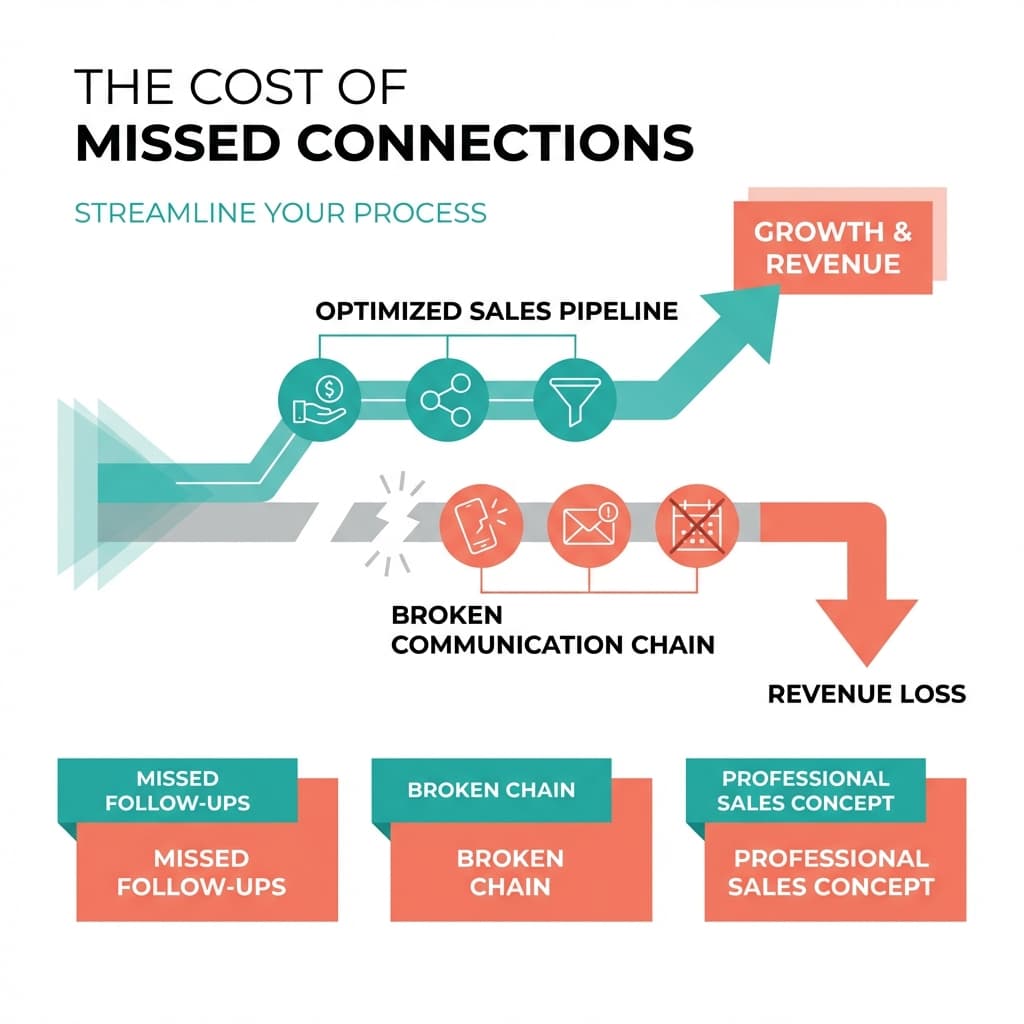
Executive Summary: The Million-Dollar Blind Spot
In boardrooms across the corporate world, sales leaders scrutinize pipeline reports, analyze conversion rates, and optimize outreach sequences. They invest in training, tools, and technology to improve sales performance. Yet there's a silent killer hiding in plain sight that receives remarkably little attention: the quality of follow-ups.
Our analysis, drawing on industry research and sales performance data, reveals a sobering reality: the average B2B sales team loses over $1 million annually to poor follow-up execution. This isn't about missed follow-ups entirely—it's about follow-ups that fail to leverage the context and connection established in previous conversations.
This is the hidden cost that doesn't show up on any dashboard but bleeds revenue from every sales organization.
Part One: Quantifying the Problem
Before we can address poor follow-ups, we need to understand their actual cost. Let's build this analysis step by step.
The Basic Math
Consider a typical B2B sales team:
| Metric | Conservative Estimate |
|---|---|
| Team size | 10 sales reps |
| Average deal size | $50,000 |
| Deals per rep per year | 15-20 (say, 17) |
| Deals influenced by follow-up quality | All of them |
Now, what percentage of deals are negatively impacted by poor follow-up? Industry research suggests this is substantial:
- 20-25% of deals are lost at least partially due to follow-up failures
- 30-40% of deals close at lower values due to diminished relationship quality
- 15-20% of deals take significantly longer to close, reducing annual capacity
Conservative Revenue Impact Calculation
Using conservative estimates:
Deals lost entirely to poor follow-up:
- 10 reps × 17 deals × 20% lost = 34 deals
- 34 deals × $50,000 = $1.7 million in lost revenue
Deals closed at reduced value:
- 10 reps × 17 deals × 80% not lost = 136 deals
- 136 deals × 30% affected × 15% value reduction = $306,000 lost
- Additional $306,000 in value erosion
Extended sales cycles:
- Harder to quantify, but represents reduced team capacity
- Conservative estimate: $200,000+ in opportunity cost
Total conservative annual impact: $2.2 million+
And this is for a modest-sized team with moderate deal sizes. For larger teams or higher-value products, the numbers scale accordingly.
Part Two: The Anatomy of a Failed Follow-Up
Understanding why follow-ups fail is essential to fixing them. Our analysis identifies four primary failure modes:
Failure Mode 1: The Timing Problem (35% of failures)
The single biggest follow-up failure is simple: too slow.
Research from InsideSales.com (now XANT) reveals dramatic data about response timing:
- Leads contacted within 5 minutes are 21 times more likely to convert than those contacted after 30 minutes
- After 24 hours, response rates drop by over 60%
- The average B2B company takes 42 hours to respond to leads
The same principle applies to follow-ups after meetings. The prospect's engagement and momentum fade rapidly. A follow-up sent 24 hours after a great conversation lands in a completely different mental context than one sent within 2 hours.
Failure Mode 2: The Context Gap (28% of failures)
This is perhaps the most insidious failure mode—follow-ups that happen on time but fail to leverage the relationship context established in previous conversations.
Symptoms of the context gap:
- Generic follow-up emails that could have been sent to anyone
- Re-asking questions the prospect already answered
- Missing references to specific pain points discussed
- Failing to acknowledge personal details the prospect shared
- Proposing solutions that don't align with stated needs
"I knew we had discussed something important about their timeline, but I couldn't remember the specifics. So I just sent a generic follow-up." — Very common sales rep experience
The context gap happens because sales reps can't remember or access the relevant details from previous conversations when crafting their follow-up.
Failure Mode 3: The Relevance Failure (22% of failures)
Even timely, personalized follow-ups can fail if they don't provide relevant value. Symptoms include:
- Follow-ups that are purely "checking in" without adding value
- Sending generic content instead of specifically relevant resources
- Missing the actual concern that's blocking the deal
- Wrong solution emphasis based on misremembered priorities
Relevance failures often stem from not deeply understanding—or not remembering—what the prospect actually cares about.
Failure Mode 4: The Persistence Problem (15% of failures)
The final failure mode is giving up too soon. Research consistently shows that most sales require 5-7 touches to close, yet:
- 44% of salespeople give up after just one follow-up
- 80% of sales require 5+ follow-ups, but 92% of salespeople give up before that
However, persistence without context compounds the other problems. Each generic "just checking in" email trains the prospect to ignore you.
Part Three: Why Context Is the Common Thread
Notice that three of the four failure modes—context gap, relevance failure, and even persistence—are fundamentally about information and memory, not effort or skill.
The timing problem is about systems and habits. But the others? They're about whether the sales rep can access and leverage the context from previous interactions.
This context problem has two components:
1. Capture: Was the information recorded?
Most conversation context never makes it into any system. CRM notes are sparse and factual. The emotional undertones, the tentative commitments, the between-the-lines signals—all lost.
A typical CRM entry: "Discovery call. Budget $50K. Decision Q2. Follow up next week."
What's missing: How did they react when you mentioned pricing? What personal pressures is the VP facing? Why are they really looking at this now? What competitor are they also evaluating?
2. Retrieval: Can the information be accessed when needed?
Even when context is captured, it often lives in disconnected places—scattered notes, Slack messages, email threads—making it impossible to efficiently brief yourself before a follow-up.
The salesperson spends 10 minutes hunting for information, gives up, and sends a generic follow-up. Or worse, doesn't follow up at all because the effort seems too high.
Part Four: The Compound Effect of Poor Follow-Ups
The immediate cost of poor follow-ups is visible in lost deals. But there's a deeper, more insidious impact: the compound erosion of relationship equity.
Relationship Equity Explained
Every positive interaction with a prospect or customer builds relationship equity—trust, goodwill, and credibility that make future interactions more productive.
Every poor follow-up withdraws from that account:
- Generic emails signal "you're not important"
- Forgotten context says "I don't really care about you"
- Repeated mistakes communicate "working with us will be frustrating"
The Bain Customer Loyalty Research
Bain & Company's research on customer loyalty provides striking context:
| Reason Customers Leave | Percentage |
|---|---|
| Felt unimportant/ignored | 68% |
| Attracted by competitor | 14% |
| Product dissatisfaction | 9% |
| Other | 9% |
Almost 70% of customer departure is driven by feeling unvalued—exactly the perception created by poor follow-ups.
Long-Term Value Destruction
Poor follow-ups don't just lose individual deals—they:
- Reduce customer lifetime value through lower expansion revenue
- Eliminate referral potential (no one refers a vendor who makes them feel unimportant)
- Create negative word-of-mouth in the industry
- Make every future deal harder to win
The true cost is not just the deal you lost today—it's the relationship value you'll never capture.
Part Five: The Excellence Standard
What does excellent follow-up look like? It's characterized by three qualities:
1. Specific Reference
Excellent follow-ups explicitly reference specific details from previous conversations:
Poor: "Following up on our discussion about your project."
Excellent: "When you mentioned that the Chicago rollout needs to happen before your IT director goes on paternity leave in May, it got me thinking about accelerated implementation options..."
2. Demonstrated Understanding
They show that you understand the prospect's specific situation and priorities:
Poor: "I think our solution could help your team."
Excellent: "You mentioned that your team is spending 30% of their time on manual data reconciliation. Based on what we discussed about your Salesforce integration, here's specifically how we could reduce that..."
3. Relevant Value-Add
They provide something specifically relevant to this prospect's needs:
Poor: "Here's a general case study about our product."
Excellent: "You asked about how we handle enterprise SSO integration. I found a case study from a company with your exact identity provider setup. The relevant section starts on page 4..."
All three qualities require retained context from previous conversations.
Part Six: Building Context-Rich Follow-Up Systems
Solving the follow-up problem requires systems that capture, organize, and surface relevant context at the right moments.
Immediate Post-Conversation Capture
The most critical intervention is capturing context immediately after every conversation, while memory is fresh. This means:
- Within 2-3 minutes of call end - Non-negotiable timing
- Voice capture preferred - 3x faster, richer context
- Focus on insights - Not transcription, but interpretation
- Structured prompts - Key decisions, next steps, emotional signals
Person-Centric Organization
Most CRM systems organize information by deal or account. But relationships are with people. Organizing captured context by person provides:
- Longitudinal view of the relationship over time
- Easy pre-call briefing on a specific contact
- Pattern recognition across interactions
- Relationship continuity even when deals change
Pre-Interaction Retrieval
The second critical point is surfacing relevant context before follow-up creation:
- Review captured notes from previous interactions
- Surface specific details, quotes, and concerns
- Remind yourself of commitments made
- Refresh emotional context of the relationship
AI-Assisted Enhancement
Modern tools can amplify these practices:
- Automatic transcription and summarization
- Entity extraction (people, companies, dates, amounts)
- Semantic search across all conversation history
- Suggested follow-up topics based on previous discussions
Part Seven: Measuring Follow-Up Quality
What gets measured gets improved. Consider tracking:
| Metric | What It Reveals |
|---|---|
| Time to first follow-up | Timing discipline |
| Follow-up personalization score | Context utilization (manual review) |
| Response rates to follow-ups | Perceived relevance |
| Deal velocity changes | Impact on sales cycle |
| Win rate by follow-up pattern | Connection to outcomes |
Even rough measurement creates awareness and drives improvement.
Conclusion: From Hidden Cost to Competitive Advantage
Poor follow-ups represent one of the largest addressable performance gaps in sales organizations. The cost is hidden because it never shows up as a line item—but it's built into every lost deal, every extended sales cycle, and every relationship that never reaches its potential.
The solution is systematic:
- Capture context immediately after every conversation
- Organize by person to build relationship intelligence
- Review before follow-ups to leverage captured context
- Measure and improve follow-up quality over time
Organizations that master this discipline create a sustainable competitive advantage. Their follow-ups stand out. Their relationships deepen faster. Their deals close more easily.
The difference between a $50,000 deal and a lost opportunity often comes down to whether the salesperson remembered—and referenced—what actually mattered in the last conversation.
That's the million-dollar value of context.
Action step: Calculate your own team's potential loss from poor follow-ups using the framework above. The number will be uncomfortably large. Let that discomfort motivate systemic improvement.
Sources & Further Reading
Never Forget Conversation Context Again
Debrief.AI captures your thoughts with voice, structures them with AI, and keeps everything organized by contact. Build your personal relationship memory.
Download for iOS