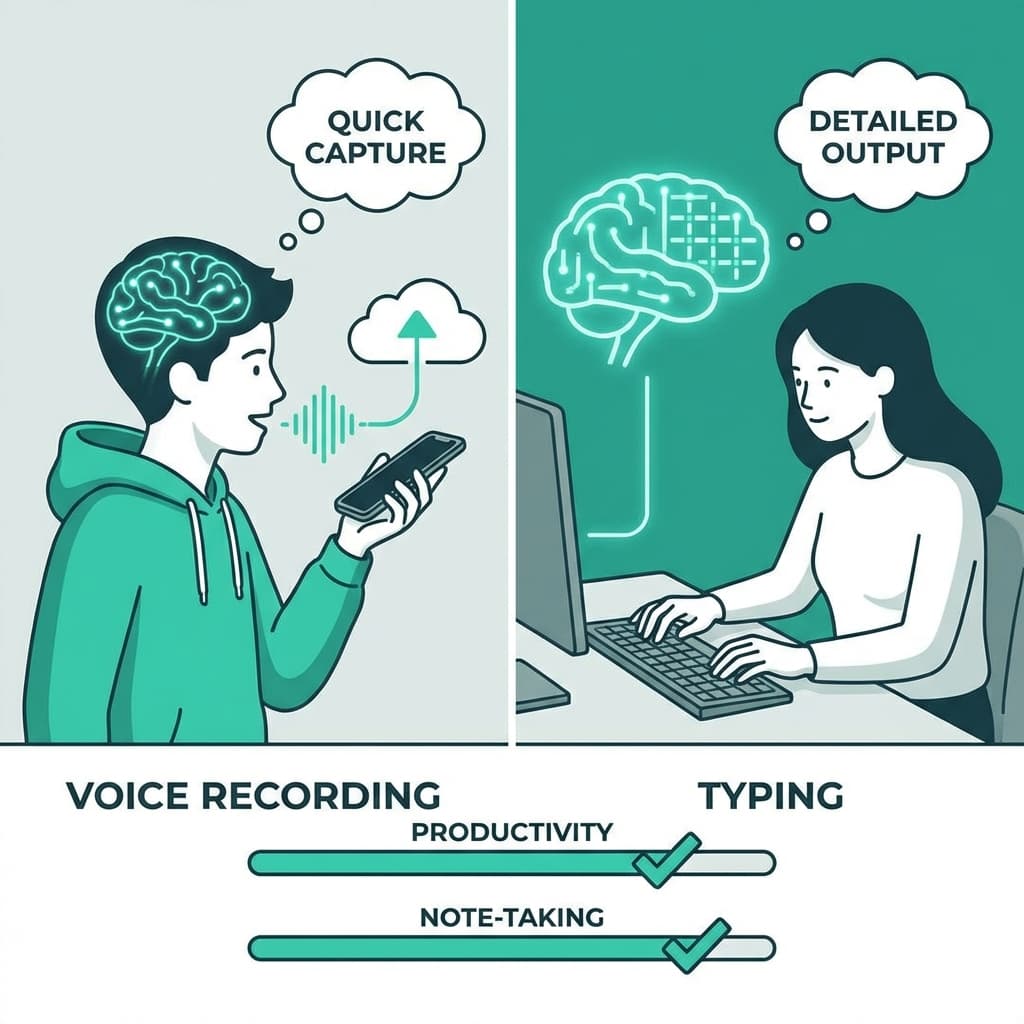
Introduction: The Note-Taking Revolution
We live in an era of unprecedented choice when it comes to capturing information. From the traditional pen and paper to sophisticated AI-powered transcription services, the options for recording our thoughts have never been more varied. Yet amidst this abundance of choice, a fundamental question persists: What is actually the most effective way to capture and retain information?
This question has taken on new urgency as our professional lives become increasingly conversation-driven. Sales calls, client meetings, team discussions, coaching sessions—the modern knowledge worker's day is filled with verbal exchanges that contain critical information. How we capture that information directly impacts our effectiveness.
In this comprehensive analysis, we'll examine what cognitive science and productivity research reveal about the relative merits of voice notes versus typed notes. The findings may challenge your assumptions about the best way to capture information.
Part One: The Speed Equation
Let's begin with the most obvious difference between speaking and typing: speed.
Raw Numbers
The average typing speed for a professional is approximately 40 words per minute (WPM). Skilled typists might reach 60-80 WPM, while hunt-and-peck typists may struggle to exceed 20 WPM.
Speaking, by contrast, typically occurs at 125-150 WPM in casual conversation, with some individuals comfortably reaching 170 WPM or more when speaking quickly.
| Input Method | Average Speed | Skilled Speed |
|---|---|---|
| Typing | 40 WPM | 60-80 WPM |
| Speaking | 125 WPM | 150-170 WPM |
| Difference | 3.1x faster | 2-2.5x faster |
This speed differential has profound implications for busy professionals. A note that takes 3 minutes to type can be spoken in under a minute. Over the course of a day with multiple calls, this time savings compounds significantly.
Beyond Raw Speed: The Friction Factor
But speed isn't just about words per minute. It's also about friction—the barriers that prevent note-taking from happening at all.
Typing requires:
- A keyboard (physical or virtual)
- A stable surface or at least two hands free
- Visual attention to the screen
- A relatively quiet environment for concentration
Speaking requires:
- A microphone (built into every smartphone)
- One tap to start
- No visual attention
- Can be done while walking, driving, or multitasking
This friction differential explains why so many professionals intend to take notes but never get around to it. Voice notes remove enough barriers that the behavior actually happens.
Part Two: The Memory Encoding Question
Speed is important, but it's not the whole story. What about actually remembering the information? Here's where the research gets fascinating.
The Princeton/UCLA Study
In 2014, researchers Pam Mueller and Daniel Oppenheimer conducted a study that made headlines: "The Pen Is Mightier Than the Keyboard." Their findings showed that students who took notes by hand outperformed those who typed on laptops in terms of conceptual understanding.
The key finding? Laptop users tended to transcribe lectures verbatim, while hand-writers—limited by their slower speed—were forced to summarize and rephrase, engaging in what psychologists call "generative processing."
"When people type their notes, they have this tendency to try to take verbatim notes and write down as much of the lecture as they can. The students who were taking longhand notes in our studies were forced to be more selective—because you can't write as fast as you can type."
This finding seemed to suggest that slower was better—that the constraint of handwriting forced beneficial cognitive processing.
But Wait: What About Voice Notes?
Here's where things get interesting for our analysis. Voice notes don't create the same transcription temptation that typing does.
When you speak your notes, you're not trying to capture every word someone said. You're naturally summarizing, interpreting, and adding your own perspective. In other words, you're engaging in the same generative processing that made handwritten notes effective—but at the speed of speech rather than the speed of writing.
Consider the difference:
Typed (verbatim tendency): "The client said they need to implement by end of Q2 and their budget is around $50,000 but they might be able to go higher if we can prove ROI..."
Voice note (natural summarization): "Big takeaway—they need to launch by end of Q2, hard deadline. Budget's around 50K but there's flexibility if we nail the ROI story. I think the CFO is the real decision-maker here based on how Sarah kept deferring to budget questions."
The voice note is actually richer in insight while being faster to create.
Part Three: The Generation Effect
One of the most robust findings in memory research is the "generation effect"—information we generate ourselves is remembered far better than information we passively receive.
This effect was first documented by Slamecka and Graf in 1978, but it has been replicated hundreds of times since. The mechanism is straightforward: when we create something, we engage more deeply with it, creating richer neural pathways and stronger memory traces.
How Voice Notes Leverage the Generation Effect
When you record a voice note after a conversation, you're not passively copying—you're actively generating:
- Selection: You're choosing what's important enough to mention
- Interpretation: You're adding your own analysis and perspective
- Connection: You're linking new information to existing knowledge
- Organization: You're structuring information in your own way
Each of these cognitive acts strengthens memory encoding. The act of creating the voice note becomes part of how you learn and remember the information.
The Retrieval Practice Bonus
There's an additional benefit: creating a voice note right after a conversation is a form of retrieval practice—actively pulling information from memory. This is known to be one of the most effective learning techniques ever studied.
Even if you never listen to your voice notes again, the act of creating them has already strengthened your memory of the conversation.
Part Four: Capturing What Typing Misses
Perhaps the most underappreciated advantage of voice notes is their ability to capture information that typed notes systematically miss.
Emotional and Contextual Information
Consider these voice note excerpts:
- "She got really animated when I mentioned the customer support issue—I think that's the real pain point, not the stuff about analytics"
- "He was hesitant, almost uncomfortable, when I asked about budget. Either he doesn't know or doesn't have authority"
- "There was this moment when the VP joined and the whole energy in the room shifted. Something's going on there"
This kind of emotional and contextual information rarely makes it into typed notes. It feels too subjective, too difficult to articulate in text. But it's often the most valuable insight from a conversation.
When you speak, these observations flow naturally. You're essentially having a conversation with your future self about what just happened.
Speed Enables Capture of Fleeting Thoughts
Another advantage: voice notes can capture thoughts before they evaporate. That insight about what the conversation really meant? That connection you just made to another client's situation? If you have to find a keyboard and type it out, it may be gone before you get there.
Voice capture is fast enough to catch these fleeting thoughts before they disappear.
Part Five: The Searchability Challenge and AI Solutions
The traditional knock against voice notes has been searchability. You can search through thousands of text notes instantly, but voice notes have historically been opaque—you'd have to listen through them to find what you need.
This limitation was significant enough that many productivity experts recommended typed notes despite their other disadvantages.
The AI Transcription Revolution
This calculus has changed dramatically with AI transcription. Modern speech-to-text technology can:
- Transcribe voice notes with 95%+ accuracy
- Process recordings in seconds
- Handle multiple speakers and accents
- Identify key topics and entities
This means you can now have the best of both worlds: the speed and richness of voice capture with the searchability of text.
Intelligent Summarization
Beyond simple transcription, AI can now summarize voice notes, extracting:
- Key action items
- Important decisions
- Questions that need follow-up
- Commitments made
This transforms a rambling three-minute voice note into a structured, actionable text summary—something that would have taken significant manual effort to create.
Part Six: Practical Recommendations
Based on the research and practical considerations we've examined, here's a framework for choosing when to use voice versus typed notes:
Use Voice Notes When:
| Situation | Why Voice Works Better |
|---|---|
| Immediately after conversations | Speed and generation effect |
| Capturing insights and impressions | Preserves emotional context |
| On the move | No keyboard needed |
| When thoughts are forming | Captures before they disappear |
| Building relationship context | Natural, rich description |
Use Typed Notes When:
| Situation | Why Typing Works Better |
|---|---|
| Creating structured documents | Templates and formatting |
| Collaborative editing | Multiple contributors |
| Quiet shared spaces | Silent capture |
| Documenting processes | Precision and detail |
| Legal/compliance needs | Clear audit trail |
The Hybrid Workflow
For most knowledge workers, the optimal approach combines both methods:
- Capture via voice - Immediately after conversations, when speed and richness matter most
- AI transcription and summarization - Transforms voice into searchable, structured text
- Review and enhance via typing - Add details, correct errors, integrate with other systems
- Store as searchable text - For long-term retrieval and reference
This workflow leverages the strengths of each modality while compensating for their weaknesses.
Part Seven: Building the Voice Note Habit
Understanding the benefits of voice notes intellectually is different from actually using them consistently. Here are evidence-based strategies for building the habit:
Reduce Friction to Zero
The goal is to make voice capture so easy that you do it automatically:
- Keep your recording app on your phone's home screen
- Use a dedicated button or shortcut if available
- Consider app that triggers after phone calls end
Create Implementation Intentions
Research by psychologist Peter Gollwitzer shows that "implementation intentions"—specific if/then plans—dramatically increase follow-through:
- "If I end a client call, then I immediately record a voice note"
- "If I leave a meeting, then I speak my three key takeaways"
Start Small
Begin with one type of interaction. Sales professionals might start with prospect calls only. Once that's automatic, expand to customer calls, then internal meetings.
Review Occasionally
Periodically listen to your old voice notes or their transcripts. This retrieval practice strengthens memory and often surfaces insights you'd forgotten.
Conclusion: The Future of Personal Knowledge Capture
We're at an inflection point in how we capture and preserve knowledge from our daily interactions. The combination of ubiquitous smartphones, AI transcription, and intelligent summarization has made voice-first note-taking not just viable but often superior to typing.
The research is clear:
- Voice is 3-4x faster than typing
- Speaking engages generative processing that strengthens memory
- Voice captures emotional and contextual information that typing misses
- AI now solves the searchability problem
For professionals whose work involves frequent conversations—sales, consulting, coaching, client services—voice-first capture represents a significant productivity and effectiveness opportunity.
The question isn't whether voice notes are better than typed notes in some abstract sense. It's whether voice notes fit better into your workflow, reduce friction enough that you'll actually capture important information, and preserve the context that makes that information valuable.
For most people, the answer is increasingly yes.
Try this experiment: For one week, capture all your post-conversation notes via voice. At the end of the week, review the transcripts. Notice how much more you captured compared to your typical typed notes. That's the voice note advantage in action.
Sources & Further Reading
Never Forget Conversation Context Again
Debrief.AI captures your thoughts with voice, structures them with AI, and keeps everything organized by contact. Build your personal relationship memory.
Download for iOS